




 Review Article
Profiting from Complaint: Adversarial Value Capture and the Longevity of Anti-Customer Business Models in the Fine Print Economy
Received Date: June 10, 2026; Published Date:June 18, 2026
Abstract
This paper examines how firms with apparently anti-customer or customer-hostile business models can continue to grow, remain profitable and retain market share despite complaints, negative publicity, regulatory scrutiny and consumer resentment. It develops the concept of the customer-grievance paradox, defined as the coexistence of customer dissatisfaction and commercial success. Ryanair is used as the focal case because it combines a famously disciplined low-cost operating model with a highly developed architecture of ancillary charges, baggage rules, priority boarding, seat selection, airport check-in fees and other customer-facing penalties. Drawing on the uploaded conceptual source paper on the Fine Print Economy, recent Ryanair FY26 results, regulatory documents, consumer-protection sources and comparative cases from banking, hotels, ticketing, telecoms, gyms, car rental, Blockbuster and Adobe, the paper argues that some firms succeed not because customers love them, but because dissatisfaction does not automatically become exit. The paper introduces three conceptual contributions: adversarial value capture, the Customer-Grievance Threshold Model, and grievance debt. It argues that fee-driven models remain viable while low headline prices, route access, market power, weak alternatives and behavioural inertia outweigh anger, hidden costs and perceived unfairness. However, these models are strategically fragile because regulation, competitor differentiation, transparency technology and consumer innovation can convert accumulated resentment into avoidance or switching. Ryanair’s strategic brilliance lies in having priced customer dissatisfaction; its vulnerability lies in the possibility that customers, regulators and innovators are learning to price it too.
Keywords: Ryanair; ancillary revenue; hidden fees; customer grievance; behavioural economics; business models; regulatory arbitrage; consumer protection
Introduction
A persistent puzzle in contemporary business strategy is that some firms remain commercially successful while many of their customers complain about them. Such firms may be accused of charging hidden fees, using punitive penalties, imposing cancellation friction, designing confusing interfaces, exploiting behavioural mistakes or structuring transactions so that the advertised price is materially lower than the eventual cost. Yet complaint does not necessarily become exit. Customers may resent a firm, criticize it publicly, and still buy from it repeatedly. This phenomenon is especially visible in sectors where customers are price sensitive, alternatives are imperfect, purchases are episodic, regulation is fragmented and the headline price dominates initial comparison.
This paper examines this puzzle through the concept of the Fine Print Economy, a term used here to describe business models in which the headline price functions as a hook and profit is recovered through ancillary fees, penalties, hidden charges, default settings, behavioural friction and information asymmetry. The paper’s central question is: How do fee-driven and customer-hostile business models remain commercially successful despite sustained consumer dissatisfaction, and what structural forces determine their long-term viability? The thesis is that anti-customer business models can remain profitable when low headline prices, weak alternatives, market power, behavioural inertia and regulatory lag prevent dissatisfaction from becoming exit. However, such models accumulate grievance debt, making them vulnerable to regulation, transparency technologies, competitor differentiation and compliance-based consumer innovation.
Ryanair provides a particularly strong focal case. It has long been associated with ultra-low fares, operational discipline and aggressive unbundling. Its customer-facing reputation is often controversial, but its commercial performance remains formidable. In its FY26 results, Ryanair reported 208.4 million passengers, a 94 per cent load factor, €15.54 billion in revenue, €4.99 billion in ancillary revenue and €2.26 billion in pre-exceptional profit after tax [1]. These figures do not support any simple claim that consumer resentment destroys commercial viability. On the contrary, they suggest that the relationship between complaint and exit is mediated by price, convenience, route access, expectations, alternatives and the customer’s belief that fees can be avoided next time.
The paper makes four contributions. First, it reframes customer-hostile fee models as a strategic phenomenon rather than merely a moral failing. Firms such as Ryanair, Ticketmaster, Adobe, hotels and banks may generate resentment, but their practices can also be economically rational within environments that reward headline-price competition and tolerate downstream extraction. Secondly, it develops the notion of adversarial value capture, whereby firms create a basic service but capture additional value through predictable customer mistakes, urgency, inattention, inertia or lack of alternatives. Thirdly, it proposes the Customer- Grievance Threshold Model, which explains when customers continue to buy despite anger and when resentment becomes exit, avoidance or regulatory demand. Finally, it introduces grievance debt, the accumulated reservoir of customer resentment produced by repeated fee extraction.
The analysis proceeds as follows. Section 2 reviews literature on business models, value capture, behavioural economics, price obfuscation, switching costs, dark patterns and customer satisfaction. Section 3 develops the Fine Print Economy framework. Section 4 explains the qualitative comparative case-study method. Section 5 analyses Ryanair as the focal case. Section 6 examines complaints and the failure of exit. Section 7 develops the idea of compliance-as-disruption in relation to baggage-fee avoidance. Section 8 compares Ryanair with other industries. Sections 9 and 10 develop the Customer-Grievance Threshold Model and grievance debt. Section 11 considers implications for managers, regulators, consumers and researchers, and Section 12 concludes.
Literature Review
Business Models, Value Creation and Value Capture
Business model theory distinguishes between how firms create value and how they capture it. Amit and Zott [2] define business models around transaction content, structure and governance, while Teece [3] argues that a business model explains how an enterprise delivers value to customers, induces payment and converts payment into profit. Much of this literature assumes that durable advantage depends on creating value that customers recognize and are willing to pay for. Strategy literature similarly emphasizes positioning, cost advantage and differentiation [4]. Low-cost strategies are legitimate and powerful where firms can deliver acceptable value at structurally lower cost.
Ryanair fits part of this traditional model. It has built a cost advantage through high aircraft utilization, standardized fleet economics, direct distribution, operational discipline and strong bargaining power with airports and suppliers. Yet the Fine Print Economy requires an additional distinction. A firm may create value through a low base service while capturing incremental value through charges that customers experience as irritating, punitive or unfair. This is not simply value creation; it is adversarial value capture. The customer receives transport, accommodation, banking, entertainment or software access, but the firm’s margin may depend on behaviours that customers would prefer to avoid. This distinction matters because conventional theories of loyalty and satisfaction do not fully explain businesses in which customers buy despite distrust. Customer satisfaction is often associated with loyalty, repurchase and positive word of mouth [5,6]. However, switching-cost literature shows that customers may remain with a provider because exit is costly, confusing or inconvenient rather than because satisfaction is high [7,8]. This distinction is crucial in the Fine Print Economy: retention can reflect tolerance rather than loyalty.
Behavioural Economics and Predictable Mistakes
The Fine Print Economy also draws heavily on behavioural economics. Consumers do not always process prices, risks and future costs with full attention. Kahneman and Tversky’s [9] prospect theory challenged the assumption that consumers evaluate options purely in terms of expected utility. Thaler [10] showed that mental accounting shapes how consumers perceive gains, losses and transactions. These insights help explain why customers may over-weight a low headline price and under-weight future or contingent charges.
The literature on shrouded attributes is particularly relevant. Gabaix and Laibson [11] argue that firms can shroud add-on prices when some consumers are myopic or unaware. Their model shows that information suppression can persist even in competitive markets because sophisticated consumers may exploit low base prices while avoiding add-ons, whereas naïve consumers crosssubsidise the model. This is highly applicable to airlines, hotels, banking and subscriptions. A customer who avoids all extras may view the low headline price as a bargain, while another customer who pays for bags, seats, check-in or changes generates the margin that supports the low visible price.
Research on partitioned pricing also supports the Fine Print Economy framework. Morwitz, Greenleaf and Johnson [12] define partitioned pricing as dividing a product’s price into mandatory parts rather than presenting a combined all-inclusive price. Their research suggests that partitioned prices can reduce consumers recalled total cost and increase demand. Greenleaf et al. [13] review the literature on partitioned pricing and show that separated fees and surcharges influence consumer perception and decisionmaking. This helps explain why firms may prefer a low base fare plus add-ons to a higher all-inclusive price, even when the final cost is similar.
Relatedly, the Federal Trade Commission defines drip pricing as advertising only part of a product’s price and revealing additional charges later in the buying process; it identifies hotels, rental cars, financial institutions, internet sellers and other sectors as contexts in which the practice appears [14]. Drip pricing is therefore not an accidental inconvenience. It is a strategy that changes what consumers compare at the beginning of a transaction.
Dark Patterns, Friction and Cancellation Difficulty
Digital markets have made it easier to engineer friction. Darkpattern research identifies interface designs that steer, obstruct, confuse or pressure consumers in ways that benefit firms [15]. Regulatory language increasingly describes these practices as harmful online choice architecture [16]. Cancellation friction, preselected options, multi-step retention flows and obscure disclosures all operate by increasing the effort required to act in the consumer’s interest.
Subscription firms provide a clear example. The FTC’s 2024 action against Adobe alleged that Adobe hid early termination fees and made subscription cancellation difficult; according to the FTC, customers could owe 50 percent of remaining monthly payments under an annual-paid-monthly plan, while cancellation required navigating numerous pages or dealing with customer-service resistance [17]. The Adobe case is not identical to Ryanair, but it shows the broader principle that friction can function as a revenueprotection mechanism.
Price Transparency, Regulation and Market Power
Consumer-protection regulators increasingly treat hidden fees as a structural market problem. The FTC’s 2024 Junk Fees Rule for live-event ticketing and short-term lodging requires businesses to disclose the total price inclusive of mandatory fees up front [18]. The FTC’s economic analysis of hotel resort fees concluded that separating mandatory resort fees from room rates without first disclosing the total price is likely to harm consumers by increasing search and cognitive costs [19]. In banking, the Consumer Financial Protection Bureau reported that overdraft and non-sufficient-funds fee revenue at banks above $1 billion in assets fell from $11.96 billion in 2019 to $5.83 billion in 2023, while consumers still paid more than $5.8 billion in such fees in 2023 [20]. In ticketing, the US Department of Justice sued Live Nation-Ticketmaster in 2024, alleging monopolization across live-concert markets and arguing that fans paid more in fees under conditions of restricted competition [21].
These examples show that fee-driven models are sustained not only by behavioural economics but also by market structure. Where consumers have no meaningful alternative, fees can persist despite resentment. Ticketmaster illustrates captive-market extraction; hotels illustrate search-cost manipulation; overdraft fees illustrate behavioural prediction and vulnerability; telecom roaming charges illustrate a model eventually weakened by hard regulation. The European Commission states that from 15 June 2017 consumers no longer pay extra for roaming while travelling within other EU countries, subject to fair-use rules [22]. This demonstrates that regulatory intervention can eliminate an entire fee architecture when political and legal conditions align.
Conceptual Framework: The Fine Print Economy and Adversarial Value Capture
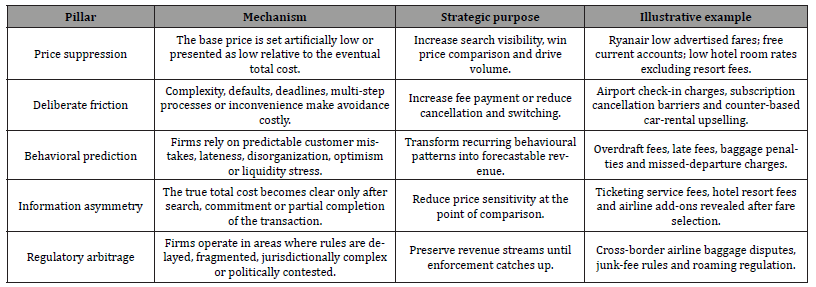
The Fine Print Economy can be defined as an economy in which the advertised price becomes a loss leader or entry hook, while profit is extracted through ancillary fees, behavioural penalties, optional upsells and hidden charges (Longford College, 2026). This paper builds on that framework by identifying five structural pillars: price suppression, deliberate friction, behavioural prediction, information asymmetry and regulatory arbitrage. The Fine Print Economy also operates through what can be described as the Revenue Extraction Pyramid. At the base is a visible fare, price or subscription advertised to attract the customer. Above it is mandatory or quasi-mandatory upsells, behavioural penalties, premium conversions and peak extraction. The higher layers become commercially powerful because the customer is already psychologically or practically committed. This differs from conventional customer-value models because it does not require the customer to perceive the firm as fair. It requires only that the customer proceed with the transaction. The following table 1 translates the Fine Print Economy into an operational framework by linking each structural pillar to its underlying mechanism, strategic function and real-world manifestation. It shows that these practices are not isolated pricing tactics but interconnected forms of adversarial value capture, in which firms use complexity, timing, behavioural tendencies and regulatory gaps to extract revenue after the consumer has already entered the transaction pathway.
Figure 1 illustrates the circular logic through which the Fine Print Economy converts low headline prices into forecastable revenue. The process begins with a low advertised price, which improves a firm’s visibility in search results, comparison websites and consumer decision-making. Because consumers often compare firms based on the first price they see, a low headline price increases conversion and produces a larger customer or passenger base. This larger volume is strategically important because it creates more opportunities for ancillary fees, penalties and optional charges to be triggered.

Table 1:Structural Pillars of the Fine Print Economy and Their Revenue-Extraction Mechanisms.
The central mechanism in Figure 1 is the relationship between customer volume and predictable fee-triggering behaviour. Firms do not need every consumer to pay every fee. Instead, they rely on recurring and statistically predictable behaviours such as lateness, confusion, urgency, liquidity stress, poor planning, baggage errors, missed deadlines or willingness to pay for convenience. These behaviours generate ancillary fee and penalty revenue. Once this revenue becomes sufficiently predictable, it supports two outcomes: first, higher forecast ability of revenue; and second, the ability to sustain low headline prices. The model therefore closes in on a feedback loop because ancillary revenue helps subsidize the very low advertised prices that attract the next wave of consumers.
The figure also identifies three possible points of disruption. Transparent competitors can disrupt the model by making total prices clearer, although they may struggle where consumers continue to rank firms by headline price alone. Regulation can disrupt the model more directly by forcing upfront disclosure, restricting certain charges or eliminating specific fee structures altogether. Consumer innovation, such as better comparison tools, fee alerts, budgeting technologies or consumer switching behaviour, can also weaken the predictability of fee-triggering conduct. However, the diagram suggests that the Fine Print Economy remains resilient where these disruptions are weak, fragmented or delayed. Its strength lies in its ability to transform consumer behaviour into a measurable revenue stream while preserving the appearance of price competitiveness.
The flywheel explains why firms may tolerate complaints. Complaint is not necessarily a break in the system; it may be a by-product of the system. If the low headline price continues to attract volume and enough customers trigger fees, resentment can be absorbed as a cost of doing business. The model fails only when grievance becomes more expensive than the fees it supports. This paper uses the term adversarial value capture to describe this dynamic. In traditional value capture, the firm captures part of the value it creates for customers. In adversarial value capture, the firm captures additional value from customer weakness, confusion, urgency, inertia or failed compliance. It does not mean that the firm creates no value. Ryanair clearly creates value by offering cheap air travel and extensive route connectivity. The point is that some of the captured value comes from a structured conflict between what the customer wants to avoid and what the firm benefits from the customer doing.
Methodology
This paper uses a qualitative comparative case-study approach. Ryanair is the focal case because it is commercially successful, heavily associated with unbundled pricing, and supported by recent financial data from its FY26 results. The comparative cases - Blockbuster, US banking, hotels, Ticketmaster, telecoms, gyms, car rental and Adobe - are used analytically rather than statistically. They illustrate recurring mechanisms across sectors: late penalties, overdraft fees, resort fees, service fees, roaming charges, cancellation friction, pressure upselling and subscription lock-in.
The evidence base consists of the uploaded Fine Print Economy source paper, the uploaded Ryanair FY26 results, Ryanair’s official fee pages, regulatory materials from the FTC, CFPB, European Commission and US Department of Justice, reputable business journalism, and established academic literature on business models, behavioural economics, pricing and switching costs. The method is interpretive and theory-building. Its objective is not to estimate the precise causal contribution of each fee to profitability, because firms do not always disclose fee-level margins. Rather, it seeks to identify the conditions under which a complaint does or does not threaten commercial viability.
The paper has three limitations. First, some fee categories are reported at an aggregate level, particularly in airline ancillary revenue, and cannot always be separated into baggage, seat selection, priority boarding, in-flight sales and commission income. Secondly, cross-industry comparisons involve different legal regimes and customer relationships; they are conceptually comparable but not identical. Thirdly, the reported Ryanair-related luggage-product dispute involving a company said to produce bags designed to fit the free baggage allowance could not be verified through a reliable direct legal or news source during preparation. It is therefore treated as a reported or illustrative case rather than a confirmed legal fact.
Ryanair as the Focal Case: Engineering the Unavoidable Fee
Low-Cost Discipline and Commercial Success
Ryanair is not merely a controversial fee machine. It is also one of Europe’s most successful airline groups. Its low-cost model depends on scale, standardization, high utilization, operational simplicity, direct selling, dense seating and disciplined cost control. This is important because the Fine Print Economy argument should not be reduced to the claim that Ryanair profits only from penalties. Rather, the airline’s customer-facing fee architecture is layered on top of a real operating advantage. The FY26 results show the strength of the model. Ryanair reported traffic growth of 4 percent to 208.4 million passengers, despite Boeing delivery delays; revenue rose 11 percent to €15.54 billion; scheduled revenue increased 14 per cent to €10.56 billion; ancillary revenue rose 6 per cent to €4.99 billion, or €24 per passenger; and pre-exceptional profit after tax rose 40 per cent to €2.26 billion [1]. The company also reported a 94 per cent load factor and expected FY27 traffic to grow to approximately 216 million passengers, with a longer-term ambition to exceed 300 million passengers per annum by FY34 [1].
These figures (show in Table 2) demonstrate the customergrievance paradox. Ryanair can be criticized for fees and service rigidity while continuing to grow. Ancillary revenue represented approximately 32.1 per cent of FY26 total revenue, using the company’s reported figures of €4.99 billion ancillary revenue and €15.54 billion total revenue. This makes ancillary revenue central rather than peripheral. It is not a small side business; it is a major layer of the model. Ryanair FY26 Performance Metrics and Strategic Significance. Ryanair provides a useful case study because it sits at the intersection of operational efficiency and fee-based value capture. The airline’s commercial strength cannot be explained solely by controversial charges or customer penalties; it also reflects a highly disciplined low-cost operating model that has allowed Ryanair to scale across Europe while maintaining high utilization and strong profitability. This section, therefore, examines Ryanair as a dual model: first, as a genuinely efficient low-cost carrier, and second, as a firm whose ancillary revenue architecture converts passenger volume into a predictable and strategically important revenue stream.
Table 2: Ryanair FY26 Performance Metrics and Strategic Significance.

Ryanair’s Ancillary Revenue Architecture
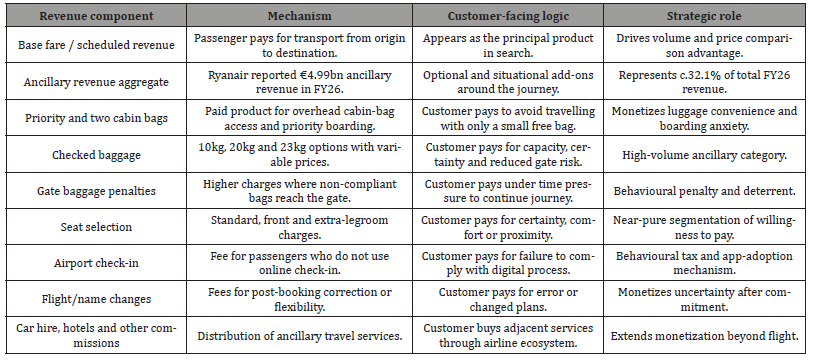
Ryanair’s fee system is an example of revenue architecture. The customer begins with a flight search and a visible fare, but the eventual transaction may include baggage, priority boarding, seat selection, family seating, airport check-in, flight changes, name changes and other charges. Ryanair’s official fees page lists, among other items, standard seat fees of €/£4.50–€/£15.50, front-seat fees of €/£7–€/£21, extra-legroom seat fees of €/£11–€/£33, an airport check-in fee of €/£55 except for specified lower fees from Spain and Austria, priority and two cabin bags at €/£6–€/£36 at booking and €/£20–€/£60 post-booking or airport, 10kg check-in bags at €/£9.49–€/£44.99 at booking, and oversized 20kg gatebag charges of €/£70–€/£75 where available [23]. Table 3 breaks Ryanair’s fee system into its main revenue components and shows how each element performs a specific strategic function within the wider revenue architecture. The table demonstrates that ancillary charges are not random add-ons but structured mechanisms for segmenting customers, monetizing convenience, penalizing noncompliance and extending revenue beyond the basic transport service. In this model, the visible fare attracts the passenger into the transaction, while the surrounding fee system converts different moments of need, uncertainty or urgency into additional revenue opportunities.
Table 3: Ryanair’s Revenue Architecture and Ancillary Fee Mechanisms.
The airline can defend this model as a matter of consumer choice: those who want the lowest fare can travel with fewer services, while those who want more convenience pay more. This argument should not be dismissed. Unbundling can be efficient where customers differ in preferences. A traveler with no luggage should not necessarily subsidize a traveler with a large bag. Yet the model becomes adversarial when the boundary between optional choice and practical necessity is ambiguous, when charges are discovered after psychological commitment, or when the customer pays because of a mistake rather than preference.
Legal and Regulatory Pressure Over Baggage Charges
Baggage charges are strategically important because they sit at the intersection of optional convenience and perceived necessity. European disputes over hand luggage illustrate this ambiguity. Consumer groups have argued that reasonably sized hand baggage should be included in the fare, while airlines argue that fare freedom and unbundling allow them to charge separately for larger or additional bags. The Guardian reported that Spanish authorities fined five budget airlines, including Ryanair, a total of €179 million in 2024 for practices such as hand-luggage and seat-reservation charges, and that a Spanish judge ordered Ryanair to refund €147 to a passenger for hand-luggage charges across five flights [24]. Yahoo Finance, republishing Telegraph reporting, stated that Ryanair received the largest Spanish fine, almost €108 million, and that Ryanair pledged to appeal the penalties as illegal [25].
The legal landscape is contested. Simple Flying reported that the Spanish refund ruling relied on reasoning that hand luggage is in principle an indispensable element of passenger transport, while also noting Ryanair’s reliance on EU Regulation 1008/2008 and airline freedom to determine fares and rates [26]. Ryanair’s own corporate statement on a Portuguese case argued that its baggage policy allows one cabin bag free of charge and complies with EU law, and that European Court of Justice precedent supports the legality of cabin-bag limits and baggage fees [27]. The point for this paper is not to decide the legal question, but to show that baggage fees have become a regulatory and reputational battleground because they reveal the tension between unbundled choice and perceived exploitation.
Complaints, Resentment and the Failure of Exit
Complaint is not exit. This distinction is the heart of the customer-grievance paradox. A dissatisfied customer may complain because a fee felt unfair, a bag was rejected, a seat-selection process was irritating, or cancellation was difficult. Yet that same customer may return if the next visible fare is lower than alternatives. In such settings, the relevant commercial variable is not affection but tolerance.
Ryanair’s model benefits from several forces that interrupt the path from dissatisfaction to switching. First, air travel is often episodic. A customer who flies twice a year may not build a continuous relationship with an airline in the way that a bank or telecom customer does. Grievance fades between purchases, while the next search begins again with price. Secondly, the customer may attribute the fee to their own behaviour: they should have checked in earlier, packed less, measured the bag, booked seats sooner or read the rules more carefully. This self-blame reduces the probability of exit even when resentment remains.
Thirdly, route convenience matters. On some routes, Ryanair may offer the best airport, schedule or fare combination. Switching to another airline may require a less convenient airport, higher total price or fewer departure options. Fourthly, customers often believe they can avoid fees next time. This optimism is central. A fee-driven model is more sustainable when customers perceive fees as avoidable penalties rather than unavoidable exploitation. The customer says, in effect, “I dislike Ryanair, but I can beat the system.” That belief keeps them inside the system.
Finally, low trust may matter less in transactional markets than in relational markets. A customer may require trust from a bank, doctor or long-term supplier, but may accept a low-trust airline for a short flight if the price is right. Ryanair therefore monetizes customer tolerance rather than customer admiration. The customer does not need to defend the brand. The customer only needs to buy.
Compliance-as-Disruption: The Baggage Innovation Problem
The uploaded brief asks particular attention to a reported case involving a compression luggage company producing bags designed to fit Ryanair’s free baggage allowance. The uploaded source paper identifies this company as Onward and presents it as a strategic example of a product that helps customers comply precisely with airline baggage rules (Longford College, 2026). However, targeted searches during preparation did not locate a reliable direct legal filing or reputable news report confirming the specific alleged Ryanair-Onward lawsuit. The case is therefore treated here as reported and illustrative, not as a confirmed legal fact.
Even with that caveat, the concept is analytically valuable. Compliance-as-disruption occurs when a product, platform or tactic helps customers obey a firm’s published rules so effectively that it disables a fee trigger. This is different from ordinary competition. A compliant baggage product does not compete with Ryanair’s flights.
It does not offer seats, pilots, aircraft, airport slots, fuel hedging or route networks. Instead, it competes with the probability that a customer will need to buy a baggage add-on or pay a gate charge
The strategic significance is profound. If a business model depends on customers crossing a threshold - arriving late, overdrawing an account, failing to cancel, exceeding baggage dimensions or accepting an upsell under pressure - then products that help customers remain below the threshold attack the revenue architecture. The firm’s own rule becomes a vulnerability. When the rule says a particular bag size is free, the entrepreneur who designs a bag to that size does not break the rule; they are weaponizing compliance. Figure 2 illustrates how a fee trigger can become vulnerable when customers learn to comply with the firm’s own rules more effectively. The process begins with Ryanair publishing baggage dimensions and fee rules. These rules are necessary for enforcement because customers must be told what counts as compliant and what will attract a charge. However, the same rules also create a clear design target for customers, luggage companies and online communities.

The next stage shows customers attempting to avoid paid baggage. This behaviour is not rule-breaking; it is rational consumer adaptation. When passengers know that exceeding a baggage limit may lead to a paid add-on or gate charge, they have an incentive to pack differently, buy compliant luggage or seek advice from other travelers. Social media and reviews amplify this process by spreading practical knowledge about which bags fit, which strategies work and how strictly rules are enforced in practice.
The central point of the figure is the emergence of a compliant luggage product or packing strategy. Such a product does not compete with Ryanair’s flight service. Instead, it competes with the probability that the passenger will trigger a baggage fee. If the customer remains within the free allowance, the baggage-fee trigger is reduced. This weakens part of the ancillary revenue architecture because revenue depends not merely on the existence of the rule, but on a predictable number of customers crossing the threshold.
The figure also shows that regulatory scrutiny can place additional pressure on the same revenue architecture. Where regulators, consumer groups or courts question the fairness, transparency or proportionality of fee practices, the firm faces pressure from both sides: customers become better at avoiding the fee, while external authorities may challenge how the fee is designed or enforced. The final stage identifies possible firm responses, including rule changes, stricter enforcement, pricing redesign or litigation. This is strategically important because it shows that compliance itself can become adversarial. The customer obeys the rule, but by doing so collectively and efficiently, customers reduce the commercial value of the rule.
This idea reveals a structural weakness in fee-dependent models. Conventional competitors attack the core product. Compliance disruptors attack the fee mechanism. The equivalent in banking is an app that prevents overdrafts; in telecoms, a plan that eliminates roaming shock; in subscriptions, a cancellationmanagement tool; in hotels, a comparison platform showing all-in price; in ticketing, legislation requiring mandatory service fees to be shown up front. These innovations do not necessarily replace the firm. They make its extraction points less reliable.
The legal and reputational paradox is that a firm may defend its right to charge for a service while objecting, explicitly or implicitly, to products that help customers avoid that charge lawfully. If a customer breaks a rule, the firm can present the fee as enforcement. If a customer complies perfectly, the moral basis for extraction weakens. This suggests that some fee-driven models depend not merely on rules, but on imperfect customer compliance with rules.
Comparative Case Studies: The Wider Fine Print Economy
Ryanair is not unique. Its model belongs to a wider family of fee-driven systems in which headline prices, penalties and friction interact. The comparative cases below show how different industries monetize customer behaviour and how those models become vulnerable.
Blockbuster and late fees
Blockbuster’s late-fee model is a classic case of grievance debt. The company’s stores created genuine convenience in the pre-streaming era, but late fees turned customer disorganization into high-margin revenue. The uploaded source paper presents Blockbuster as an example of a firm whose late fees became emotionally toxic once Netflix offered a no-late-fee subscription model (Longford College, 2026). The strategic lesson is that Netflix did not merely offer convenience; it offered relief. The absence of a disliked fee became part of the value proposition. Blockbuster illustrates how fee revenue can build a business while weakening its emotional foundation. Customers might tolerate late fees when alternatives are limited, but they do not defend the fee once a credible alternative appears. The late fee becomes a memory of humiliation, not a neutral price.
US Banking and Overdraft Fees
Overdraft fees illustrate behavioural prediction. Banks can predict that a subset of customers will overdraw accounts, often under conditions of short-term liquidity stress. The CFPB reported that overdraft and NSF revenue at banks above $1 billion in assets reached $11.96 billion in 2019 and remained $5.83 billion in 2023 despite major reductions [20]. The fee is profitable precisely because the triggering behaviour is recurrent and unevenly distributed. The ethical and strategic fragility arises from perceived vulnerability. Unlike a seat upgrade, an overdraft fee often falls on customers least able to absorb it. Fintech challengers and regulatory pressure weaken the model by offering alerts, fee-free buffers, instant balance visibility or alternative credit structures. These tools convert what was once a predictable mistake into an avoidable event.
Hotels and Resort Fees
Hotel resort fees are a paradigmatic form of information asymmetry. The consumer searches for a room rate, compares results, and only later discovers mandatory fees. The FTC’s economic analysis concluded that separating mandatory resort fees from room rates without first disclosing total price is likely to harm consumers by increasing search and cognitive costs [19]. The FTC’s 2024 Junk Fees Rule responds to this problem by requiring up-front all-in pricing for short-term lodging and live-event ticketing [18]. Hotels show why the Fine Print Economy can distort competition. A hotel that includes all mandatory fees in the headline price may appear more expensive than a hotel that separates them. The opaque firm can win the search result even if its final price is no lower. Regulation therefore does not merely protect consumers; it can also protect honest competitors from being punished for transparency.
Ticketmaster and Captive-Market Fees
Ticketmaster differs from Ryanair because the customer often has no meaningful substitute. A fan who wants to see a particular artist at a particular venue cannot usually choose another ticketing platform. The DOJ’s 2024 lawsuit against Live Nation-Ticketmaster alleged monopolization across live-concert markets, long-term exclusive contracts and practices that harmed fans, artists, venues and innovation [21]. The DOJ argued that fans paid more in fees under conditions of restricted competition. This case demonstrates that grievance can persist where market power prevents exit. Customers may hate service fees but cannot switch without abandoning the event itself. In such markets, complaint becomes political and regulatory rather than competitive. The customer cannot discipline the firm through ordinary market choice, so the state becomes the potential counterweight.
Telecoms: Roaming and Overage Charges
Telecoms provide two contrasting disruption paths. In the European Union, roaming charges were weakened by regulation. The European Commission states that from 15 June 2017, consumers travelling in other EU countries no longer paid extra for calls, texts and mobile data under Roam Like at Home, subject to fair-use rules [22]. This is a clear example of regulatory abolition of a fee architecture. In the United States, competitive differentiation also played a role in weakening overage and contract-based fee models. Firms can attack fee culture by sacrificing a disliked revenue stream to gain customers. The strategic lesson is that fee models can be undone either by law or by competitors willing to convert customer resentment into a positioning advantage.
Gyms, Subscriptions and Cancellation Friction
Gyms and subscriptions monetize inertia. Low monthly prices appear harmless, while unused memberships, annual fees, freetrial conversions and cancellation friction sustain revenue. The business does not require the customer to use the service; in many cases, underuse is economically attractive because the firm collects payment without incurring proportional variable cost. This model is strategically similar to Ryanair’s check-in and baggage rules because it depends on behaviour that customers later regret: forgetting, postponing, underestimating friction or overestimating future discipline. Regulation such as click-to-cancel rules directly targets this architecture by making exit as easy as entry.
Car Rental and Counter-Based Pressure
Car rental firms use a different form of friction: the pressure of the counter. A customer who booked a low daily rate online arrives tired, time-constrained and possibly unfamiliar with local insurance requirements. Add-ons such as collision damage waivers, fuel pre-purchase, toll packages, GPS and liability products are sold at the moment when refusal feels risky. The FTC’s drippricing materials identify rental cars as one of the contexts in which later-stage surcharges and add-ons can affect consumer choice [14]. This is not hidden pricing alone; it is situational power. The customer is already at the desk, often after a flight, with limited appetite for comparison. The extraction point is therefore not only informational but emotional.
Adobe and Big Tech Subscription Lock-In
Adobe represents digital lock-in and cancellation friction. The FTC’s 2024 complaint alleged that Adobe pushed customers towards annual-paid-monthly subscriptions, hid early termination fees and made cancellation difficult through multiple pages, dropped calls, transfers and resistance [17]. Adobe’s case illustrates the digital version of the Fine Print Economy: the fee is not a bag at the gate but a penalty embedded in subscription architecture.
Big Tech subscription models also demonstrate the importance of dependency. When a tool becomes an industry standard, switching costs rise. Customers may dislike fees or cancellation terms but remain because files, workflows, collaborators, skills and professional norms are locked into the platform. The more embedded the product, the more grievance the firm can carry without immediate exit. Table 4 extends the analysis beyond Ryanair by comparing fee-based and friction-based revenue models across several sectors. The comparison shows that the Fine Print Economy is not confined to airlines or physical add-ons, but appears wherever firms can combine a low entry price with delayed charges, customer inertia, behavioural vulnerability or switching costs. Adobe and other Big Tech subscription models are especially important because they demonstrate how the same logic operates in digital markets: once users become dependent on a platform, cancellation friction, annual lock-ins and termination penalties can convert professional necessity into predictable revenue retention.
Table 4: Cross-Sector Examples of Fine Print Revenue Models and Disruption Risk.

Discussion: Why Anti-Customer Models Survive
The comparative evidence suggests that anti-customer or feedriven models survive under identifiable conditions. They are not irrational. They are often rational responses to environments in which consumers sort by headline price, comparison tools underweight downstream costs, firms can segment willingness to pay, and regulation lags innovation. The first survival condition is high price sensitivity. When customers strongly prefer low visible prices, firms are rewarded for moving costs out of the headline price and into later stages of the transaction. The second is weak or inconvenient alternatives. Ryanair may remain attractive where alternatives are more expensive, less direct or less frequent. Ticketmaster remains powerful where the desired event is tied to its platform. Adobe remains powerful where professional workflows depend on its software. The third condition is customer optimism. Many customers tolerate fee-driven models because they believe they can avoid the fee. This optimism divides the customer base. Sophisticated customers may obtain low base prices while avoiding extras, while less attentive or less flexible customers pay. This is consistent with Gabaix and Laibson’s [11] account of shrouded addons, in which sophisticated consumers can benefit from systems funded by myopic consumers.
The fourth condition is episodic interaction. If customers encounter the firm only occasionally, grievance may not accumulate fast enough to dominate the next purchase decision. The fifth condition is fragmented regulation. Cross-border airlines, online platforms and multinational subscription firms operate across jurisdictions, making enforcement slower and less uniform. Finally, the sixth condition is difficulty coordinating consumer backlash. Millions of consumers may complain individually without producing collective discipline. Figure 3 brings together the sustaining and eroding forces that determine whether a feedriven business model remains commercially viable. The model shows that customer grievance alone does not necessarily destroy a firm’s strategy. Instead, grievance must exceed a threshold at which consumers, competitors, regulators or courts begin to impose meaningful discipline on the firm. Until that point, low headline prices, route convenience, behavioural inertia, market power and customer optimism can allow the fee-revenue cycle to continue despite widespread dissatisfaction.
Figure 3 illustrates why anti-customer or fee-driven models can survive even when customers openly dislike them. The left side of the diagram identifies forces that sustain the model. Low headline prices attract consumers at the search stage; route convenience or platform dependency reduces the practical attractiveness of alternatives; behavioural inertia makes customers slow to switch; and market power limits the ability of competitors to discipline the firm. Customer optimism also plays an important role because many consumers believe they can avoid fees through careful behaviour, even when the system is designed around predictable mistakes, urgency or inconvenience. The central cycle shows how these conditions feed into the revenue architecture. A low advertised price improves search ranking and conversion, generating large passenger or customer volume. That volume creates a wider base of consumers who may trigger fees through baggage errors, late action, cancellation friction, overdrafts, overages, upsells or other predictable behaviours. These behaviours produce ancillary fee and penalty revenue, which increases the forecastability of revenue. Once ancillary revenue becomes reliable, the firm can continue advertising low headline prices, completing the loop.

The diagram also shows that the model is not invulnerable. Accumulated grievance can eventually attract regulatory attention, encourage legal challenges, support transparent competitors, generate social media backlash or create demand for compliance products that help consumers avoid fees. These eroding forces disrupt the system at different points. Regulation can attack the rules themselves; transparent competitors can undermine the headline-price advantage; consumer innovation can reduce feetriggering behaviour; and legal challenges can increase the cost of maintaining the model.
The significance of the Customer-Grievance Threshold Model is that it explains why dissatisfaction and profitability can coexist. A firm can generate complaints, poor reviews or reputational damage while still growing if the sustaining forces remain stronger than the eroding forces. The model begins to weaken only when grievance becomes organized, alternatives become credible, regulation becomes enforceable or customers acquire tools that reduce the predictability of fee extraction. Table 5 translates the Customer- Grievance Threshold Model into a set of longevity conditions. While Figure 3 shows the dynamic interaction between sustaining and eroding forces, the table identifies the specific conditions that allow fee-driven models to persist and the circumstances under which those conditions begin to fail. The central point is that anticustomer models do not collapse simply because consumers dislike them. They weaken when the structural supports that protect them - low visible prices, weak alternatives, customer optimism, market power, behavioural inertia, fragmented regulation and episodic purchasing - are disrupted by transparency, credible substitutes, regulatory coordination or accumulated consumer learning. This model explains why complaints alone are insufficient. A complaint is evidence of dissatisfaction, not evidence that the threshold has been crossed. The threshold is crossed when anger combines with a credible alternative, a regulatory pathway, a consumer workaround or a reputational cascade.
Table 5: Why Fee-Driven Models Survive and When They Fail.

The Limits of the Model: Grievance Debt and Strategic Fragility
Grievance debt is the accumulated reservoir of resentment created when firms repeatedly extract value through fees, penalties, friction or perceived unfairness. It is debt because it represents a claim against future trust. The firm receives cash now, but the customer stores resentment that may later be activated by a competitor, regulator or workaround. This concept explains why fee revenue can be both profitable and dangerous. A €55 airport checkin fee, a $35 overdraft charge, a hotel resort fee or a subscription cancellation penalty may be rational in isolation. Each generates revenue from a customer who has limited immediate alternatives. Yet each also teaches the customer that the firm is willing to profit from their mistake or constraint. Over time, the customer may continue to buy, but rarely becomes an advocate.
Blockbuster shows what happens when grievance debt meets emotional relief. Netflix’s no-late-fee model did not merely improve convenience; it transformed accumulated annoyance into exit. Telecom roaming shows the regulatory version: once the EU converted roaming resentment into law, the fee architecture disappeared for ordinary intra-EU travel. Adobe shows the enforcement version: cancellation friction that may have protected revenue became the basis for regulatory complaint.
For Ryanair, the risk is more complex. Ryanair has a stronger cost advantage than many fee-dependent firms and provides a service that customers demonstrably continue to value. Its FY26 results suggest that grievance debt has not yet overwhelmed the model. The airline’s low fares, network, operational scale and cost discipline remain powerful sustaining forces. Moreover, customers can rationally prefer unbundling if it lets them avoid paying for services they do not use. However, Ryanair’s vulnerability lies in the visibility and emotional intensity of fee triggers. Baggage disputes occur at the airport, under time pressure, in public, with the journey at stake. Airport check-in fees feel punitive because the marginal cost of issuing assistance may appear lower than the charge. Seat charges for families or dependents attract regulatory attention because they involve perceived fairness, not only price. These are not neutral add-ons; they are grievance-producing moments.
The model can be weakened through three routes. The first is regulation, including all-in pricing, fee caps, mandatory inclusion of reasonably sized hand luggage, limits on family seating charges or stronger disclosure rules. The second is competition, where rivals position themselves as transparent, less punitive or emotionally easier. The third is consumer innovation, where products, apps, comparison tools and tactics help customers avoid fee triggers. Table 6 develops the concept of grievance debt by identifying the main pathways through which accumulated consumer resentment can become a strategic threat. The table shows that fee-driven models are not weakened only by direct customer exit; they can also be disrupted by regulation, competitor positioning, transparency tools, consumer innovation, litigation and reputational backlash. For Ryanair, this matters because its strongest fee triggers often occur at emotionally charged moments, such as baggage disputes, airport check-in problems or seating concerns. These moments may generate revenue in the short term, but they also create stored resentment that can later be activated by rivals, regulators, courts or consumer workarounds.
Table 6: Grievance Debt and Disruption Pathways in Fee-Driven Business Models.

Implications
Implications for Managers
For managers, the central lesson is that fee-driven revenue should be evaluated not only by margin but also by grievance cost. Traditional accounting records the fee as revenue but rarely records the corresponding trust withdrawal. Managers should therefore ask whether a fee is perceived as a fair price for an optional service, a reasonable cost allocation, or a punishment for human error. The same euro of revenue has different strategic consequences depending on which category customers perceive. Ryanair’s model shows that a firm can deliberately accept low affection if it delivers compelling price and convenience. However, managers should not confuse tolerance with loyalty. Customers who tolerate a firm are available to any competitor that can preserve the economic benefit while removing the emotional pain. Fee-dependent firms should therefore identify which fees are defensible, which are merely irritating, and which create disproportionate grievance debt.
Implications for Regulators
For regulators, the Fine Print Economy raises the question of when disclosure is enough. If customers can understand and avoid a fee with reasonable effort, transparency may be sufficient. If a fee is mandatory, unavoidable, hidden until late in the transaction or imposed under conditions of pressure, stronger intervention may be justified. The FTC’s all-in pricing rule for hotels and live-event tickets reflects the view that mandatory fees should be visible at the beginning of comparison [18]. The EU’s roaming intervention shows that some fee models may require hard legal limits rather than better disclosure [22]. Airline baggage fees are more difficult because unbundling can be efficient. Regulators must distinguish between optional extras, practically necessary services and penalties that exploit time pressure. A defensible policy could permit airlines to charge for additional capacity while requiring clearer all-in comparison, minimum free hand-luggage standards and proportionate treatment of families or dependents.
Implications for Consumers
For consumers, the analysis shows that individual discipline matters but is not always enough. Measuring bags, checking in early, using price-comparison tools, setting cancellation reminders and reading fee rules can reduce exposure. Yet the Fine Print Economy often shifts cognitive labour onto consumers. A market that requires every consumer to become a contract analyst is not necessarily efficient; it may simply be transferring search and error costs from firms to households. Consumers also have collective power through reviews, complaints, litigation support and adoption of transparent alternatives. Compliance products are especially interesting because they avoid moral confrontation. They do not ask the firm to change; they help the customer obey the rule so precisely that the fee disappears.
Implications for Researchers
For business model theory, the implication is that scholars should pay more attention to adversarial value capture. Much strategy research focuses on innovation, value creation and customer loyalty. The Fine Print Economy shows that firms can also build durable models around value extraction from friction, confusion, inertia and behavioural prediction. These models deserve analysis not because they are admirable, but because they are commercially significant. Future research could measure grievance debt empirically by combining complaint data, repeat purchase behaviour, brand sentiment, fee exposure and switching events. Researchers could also compare sectors where fee models collapsed with sectors where they persisted, identifying the conditions under which resentment becomes commercially actionable.
Conclusion
The longevity of anti-customer business models is not mysterious once complaint is separated from exit. Customers may resent a firm and still buy from it when the visible price is low, the route is convenient, alternatives are weak, the purchase is episodic, the fee appears avoidable and regulation is delayed. Ryanair exemplifies this customer-grievance paradox. It is frequently criticized for fees and customer-facing rigidity, yet its FY26 results show rising traffic, substantial ancillary revenue and strong profitability. The Fine Print Economy is built on a strategic reallocation of price. The base fare or entry price attracts the customer; the profit is recovered through ancillary charges, behavioural penalties, premium conversions and moments of friction. This model is not irrational. It can be a sophisticated response to price comparison, behavioural bias and market structure. Yet it is fragile because it accumulates grievance debt. Customers may tolerate such firms, but they rarely defend them.
Ryanair’s future vulnerability is therefore unlikely to come only from another airline offering the same route at a lower fare. It may come from regulators clarifying hand-luggage rights, comparison tools showing true trip cost, rivals offering emotional simplicity, or consumer products that eliminate baggage-fee triggers through perfect compliance. The deeper lesson is that when a company profits from customer mistakes, every innovation that prevents those mistakes becomes a competitor. Anti-customer business models can last for a surprisingly long time when economic conditions are favourable. They survive while resentment is cheaper than exit. They weaken when a regulator, competitor or consumer workaround converts resentment into action. Ryanair’s strategic brilliance lies in having priced customer dissatisfaction; its strategic vulnerability lies in the possibility that customers, regulators and innovators are now learning to price it too.

- Ryanair Holdings plc (2026) Ryanair 2025–26 PAT rises 40% to €26bn (pre-exceptional); traffic grows 4% to 208m despite Boeing delays. User-uploaded FY26 results PDF.
- Amit R, Zott C (2001) Value creation in e-business. Strategic Management Journal 22(6-7): 493-520.
- Teece DJ (2010) Business models, business strategy and innovation. Long Range Planning 43(2-3): 172-194.
- Porter ME (1985) Competitive Advantage: Creating and Sustaining Superior Performance. New York: Free Press.
- Oliver RL (1999) Whence consumer loyalty?. Journal of Marketing 63(Special Issue): 33-44.
- Reichheld FF, Sasser WE (1990) Zero defections: Quality comes to services. Harvard Business Review 68(5): 105-111.
- Klemperer P (1987) Markets with consumer switching costs. The Quarterly Journal of Economics, 102(2): 375-394.
- Klemperer PD (1995) Competition when consumers have switching costs: An overview with applications to industrial organization, macroeconomics, and international trade. The Review of Economic Studies 62(4): 515-539.
- Kahneman D, Tversky A (1979) Prospect theory: An analysis of decision under risk. Econometrica 47(2): 263-291.
- Thaler RH (1985) Mental accounting and consumer choice. Marketing Science 4(3): 199-214.
- Gabaix X, Laibson D (2006) Shrouded attributes, consumer myopia, and information suppression in competitive markets. The Quarterly Journal of Economics 121(2): 505-540.
- Morwitz VG, Greenleaf EA, Johnson EJ (1998) Divide and prosper: Consumers’ reactions to partitioned prices. Journal of Marketing Research 35(4): 453-463.
- Greenleaf EA, Johnson EJ, Morwitz VG, Shalev E (2016) The price does not include additional taxes, fees, and surcharges: A review of research on partitioned pricing. Journal of Consumer Psychology 26(1): 105-124.
- FTC (2012) The Economics of Drip Pricing. Federal Trade Commission.
- Mathur A, Kshirsagar M, Mayer J (2021) What makes a dark pattern... dark? Design attributes, normative considerations, and measurement methods. Proceedings of the 2021 CHI Conference on Human Factors in Computing Systems. New York: ACM.
- Competition and Markets Authority (2022) Online choice architecture: How digital design can harm competition and consumers. London: CMA.
- FTC (2024a) FTC Takes Action Against Adobe and Executives for Hiding Fees, Preventing Consumers from Easily Cancelling Software Subscriptions. Federal Trade Commission.
- FTC (2024b) Federal Trade Commission Announces Bipartisan Rule Banning Junk Ticket and Hotel Fees. Federal Trade Commission.
- Sullivan MW (2017) Economic Analysis of Hotel Resort Fees. Federal Trade Commission.
- CFPB (2024) Overdraft/NSF Revenue in 2023 down more than 50% versus pre-pandemic levels, saving consumers over $6 billion annually. Consumer Financial Protection Bureau.
- US Department of Justice (2024) Justice Department Sues Live Nation-Ticketmaster for Monopolizing Markets Across the Live Concert Industry.
- European Commission (2026) The history of roaming.
- Ryanair (2026a) Fees.
- Wood Z, Topham G (2025) Calls for EU to intervene in row over charges for hand baggage on budget airlines. The Guardian, 26 May.
- Price C (2024) Ryanair and easyJet fined over £100m for ‘abusive’ baggage fees. Yahoo Finance / The Telegraph, 22 November.
- Patel P (2025) Ryanair Loses Legal Battle For $165 Of Extra Baggage Charges. Simple Flying, 9 May.
- Ryanair (2024) Ryanair welcomes reversal of Portugal court ruling on Ryanair bag policy.
-

This work is licensed under a Creative Commons Attribution-NonCommercial 4.0 International License.




